
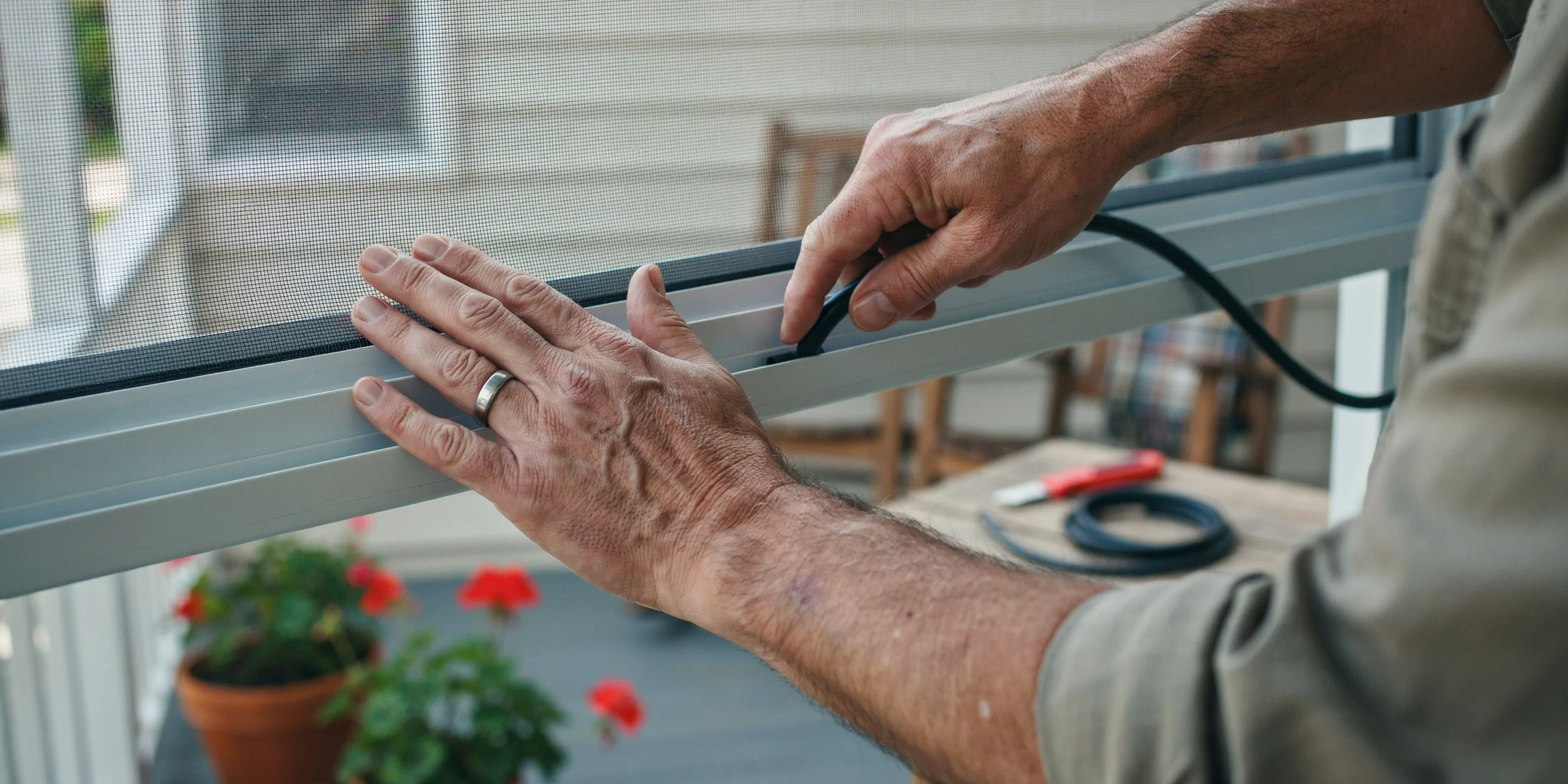
The 1950s and 60s ranches on Venice Island and in Venice Gardens were built with screened porches and under-truss lanais, not pool cages. The mesh and spline are no different from a cage's, yet a porch frame is bolted to the house, its panels run low and wide, and its door absorbs most of the daily abuse. Because the wear pattern is different, the rescreen approach on these porches is different too.
The knee-height panels fail first on a Venice Gardens porch because that is where shoes, chair legs, dogs, and the pressure-washer wand all land. After those, the door mesh gives out, worn by the flex of the frame each time someone goes through. Sun-facing walls chalk and go brittle ahead of the shaded ones, and Gulf air speeds all of it up. The contractor rescreens what has actually worn: on a porch that aged evenly that means every panel, while on one that has not it might be only the lower band, the door, and the wall that faces west.
Most Venice porches get standard 18/14 fiberglass, since the point of a lanai is moving air. Creek-side and bayfront porches in Nokomis and Osprey often take a tighter 20/20 weave on the wall that faces the mangroves. Homes with dogs take a pet-grade band along the bottom with standard screen above it. One porch can carry any combination of these meshes, wall by wall.
If the door drags or will not latch, have it fixed during the rescreen; fresh mesh set into a warped door frame does not stay tight for long. On the older porches it is also the moment to look at the frame finish and the screws. Chalked aluminum and rust-streaked screw heads are the case for a full makeover rather than a rescreen alone.
Replacing mesh inside an existing lanai frame generally does not require a permit from the City of Venice or Sarasota County. Enclosing an open lanai with new screen walls, or straightening and replacing bent frame members, is different and does need one. The contractor handles it when a permit is required.
Call (941) 676-8878 or request your FREE, no obligation written estimate online.
 Standing by
Tell us what you're seeing and pick a time for the visit. Your contractor looks at the cage in person and puts it in writing. Keep what's solid. Replace what's worn.
Every screw connection in the cage renewed with marine-grade stainless steel. The least visible part of a renovation and the one that matters most when the wind comes back.
Single panels and small sets: torn mesh, blown spline, sagging sections. Mesh matched to the existing weave and color so the repair disappears.
Doors that drag, slam, or will not latch. New mesh, hinges, closers, latches, and kick plates, or a new door hung square when the old one is past adjusting.