
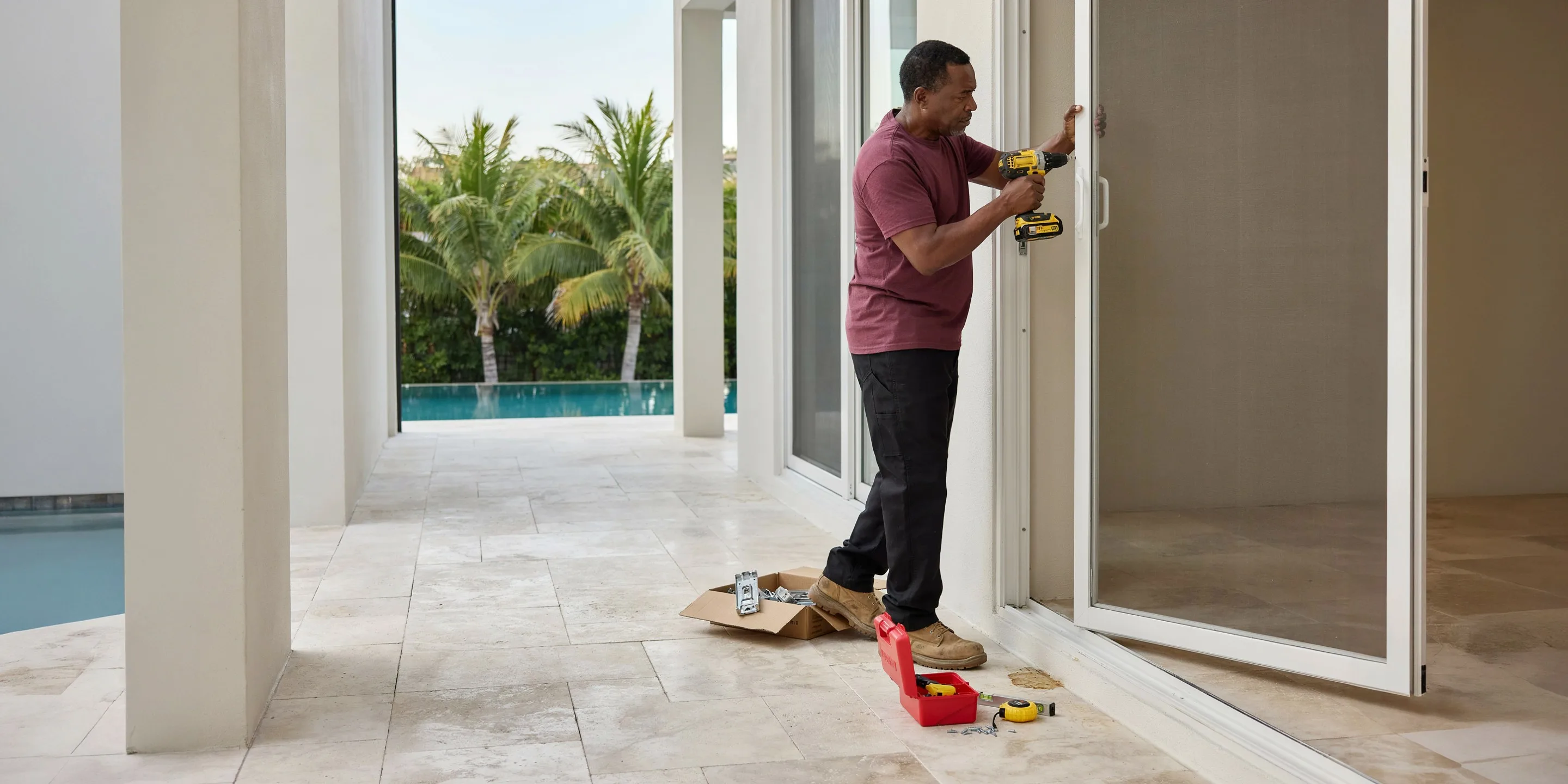
The door is the hardest-working part of any lanai or pool cage. It swings a dozen times a day, it takes the pressure washer and the dog, and it is the panel people push through with their hands full. When it drags, slams, will not latch, or has torn at the kick plate for the third time, the door needs attention on its own, not just another piece of mesh.
A good share of Venice cage doors need nothing more than tuning, which means seating the hinges again, bringing the closer back up to tension, and lining the latch up so it clicks shut without a push. Others need parts. For an aluminum cage door that means hinges, a pneumatic closer, a latch, or a kick plate sized to that frame, and the contractor keeps the usual sizes on the truck. If the frame has twisted out of square, the hinge corners have corroded, or repeated re-meshing has worn the spline channel smooth, your money goes further on a new door set plumb in the opening. Which of these applies is something the contractor settles with you during the visit.
No wall panel on the cage gets hit as hard as the mesh in the door. Standard 18/14 is fine on a lightly used door; pet-grade vinyl polyester on the lower half is the usual answer where dogs go in and out. A kick plate across the bottom rail keeps shoes and dragged chairs off the mesh.
Under Florida's residential pool barrier rules, a cage door is expected to close and latch on its own and to swing outward, away from the water. That makes a slack closer or a latch that misses the strike a safety problem first and an annoyance second. Both get checked whenever the contractor is out on a Venice door call.
Door work pairs naturally with a lanai or porch rescreen, and on older cages a new door is often the finishing touch on a makeover. Door hardware and re-meshing inside an existing frame generally do not require a permit.
Call (941) 676-8878 or request your FREE, no obligation written estimate.
 Standing by
Tell us what you're seeing and pick a time for the visit. Your contractor looks at the cage in person and puts it in writing. Keep what's solid. Replace what's worn.
A before-June walk-around: cable tension and anchors, fastener condition, spline and mesh, door hardware, with a written punch list you can schedule from.
The makeover: chalked, oxidized aluminum cleaned, prepped, and refinished, with stainless hardware and fresh screen done in the same project. The cage you have, looking like the cage you bought.
Full or partial mesh replacement on aluminum pool enclosures. Walls, roof panels, or the whole cage, with new spline throughout and mesh matched to how the cage faces.